Tuesday, 26 July 2016

a process that works itself


One of the things I'm observing as my content arises is different qualities of line, and I often wonder about the processes of control or otherwise over such qualities. When I'm not thinking at all, doing something like trying out a pen, images appear that wouldn't have come from a different frame of mind.

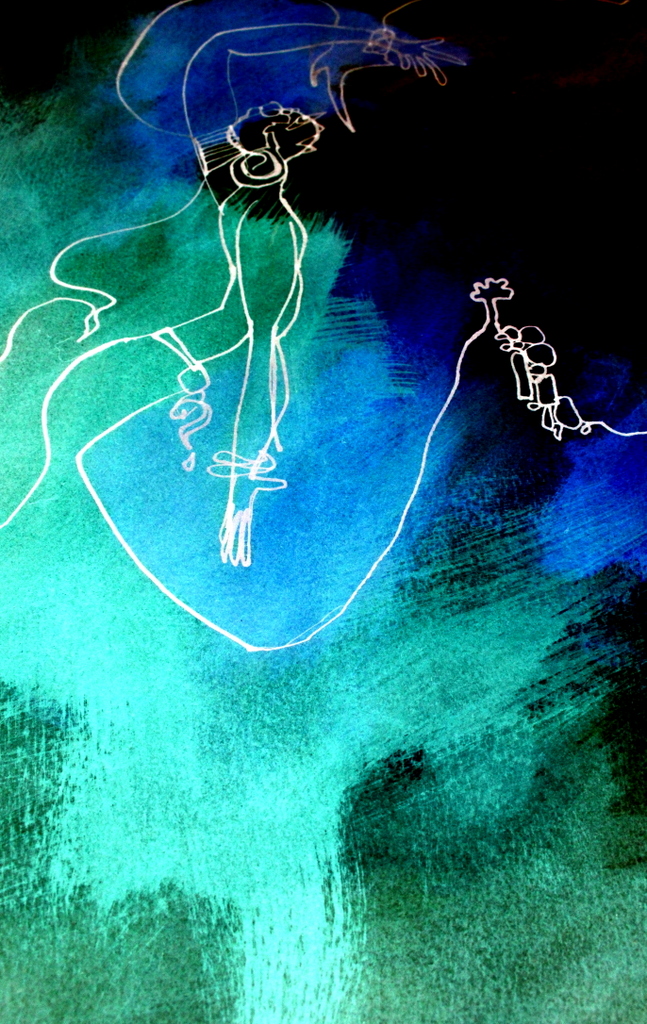
Below is one such pen-trying-out image. I would never have made this if I'd had any even partial thought of 'maybe selling' or even  'maybe sharing'. Both the line and the use of colour were made pretty much without thought.


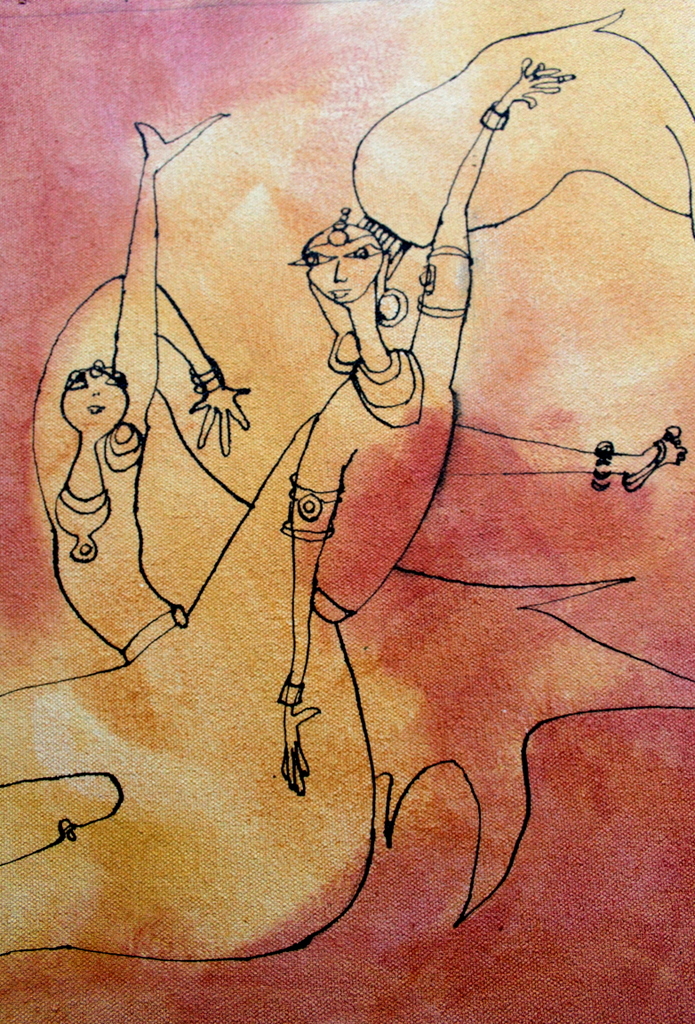
The second image below has some of these qualities but not others. It wasn't intended to become an image that might be sold or shared. It was an experiment on canvas, a material which is still new to me, especially when using a pen. But though I had no plan for the image before I started and no idea about how it would turn out,  I was very conscious of the line moving more slowly and carefully on this more permanent material.


I have to acknowledge that I made a whole lot of similarly experimental images in my first years back at painting, and many of them ended up being exhibited and sold. Much of what I currently sell or share follows the same process of experimentation; of trying not to think, hoping to surprise myself etc, and it's only afterwards that I select.

The qualities that most interest me appear much more in the first of the two images above than in the second.


Some people might say that what I'm doing are 'studies'. But studies for what? If if I find that the freer, less intentional drawings have the qualities that I want, and the more conscious ones usually don't, what would I be making studies for?


All of my working is a kind of learning-by-doing. The qualities of materials that I want to learn about can't be understood in any other way. To some extent it doesn't really matter to me at the moment what image arises, or what colours and marks end up on the page. The main thing is just to keep making lines and putting on paint. Something emerges, moves and grows, just in the act of keeping going.


.

Wednesday, 20 July 2016

emergence


It is time.

Crawl up from the underworld.
Depart your long stay in
thick darkness and clay.

Find your roots.

Find your roots.

Follow - straight or
spiralling - to the surface and
into the humid,
star-storied night.

Proceed, slowly, yes,
but with the unyielding intent
to become the amazing thing
that you have never before
seen.

Can you feel your soft, tender body
up against the inside of your
dry, tight, skin?

The edge. The tightness.
It tears you apart...

this back-splitting longing to
be larger that that which has
contained you.

I know that dream.

The one about having wings.

So, find that place where you will,
consciously,
take the last step
as who you have been,
unfold your future,
and cast the old story behind you.

Emerge. Break free.

Surrender to your destiny,
lifting your long struggled forth form
onto a tree trunk,
or a flower stalk.

The moistness.
It is always there -
conception, growth,
birth, life, death.

Notice the eyes.

Red.

Let the soft dawning breezes
caress your sensitive nature,
as you unfurl lacy,
iridescent dreams.
So clear.

Now firm in the daylight.
You are seen.

Listen.

The world is calling to you.

Let yourself be heard.

Trust in what you have been
gifted.

Trust in what you have been
gifted.

Take flight -

with this core truth:

Where you land
and what you do
will determine
how well grounded
we are in the future.


.

Saturday, 16 July 2016

exactitude


I can draw 'accurately'. But learning to draw accurately always seemed strangely wrong for me. The act of making precise ('exactitude is not truth') , or attempting to make precise, seemed to kill something. That's why I was so excited when my line broke free in India. Something felt different, began to live. Many years later, a friend would look at those Indian drawings and say that they were in some way naive. I was quite taken aback, because for me the line had advanced towards something much more exciting.

I guess people look at Indian folk art and similarly say that the images are naive. For me this misses the point. This is a symbolic world, a world where images can provoke resonance, deep within the viewer. Or they may not. But the image emerges from a complex human/larger world interface (Kapoor's 'content arising') rather than being the result of a concept or a willed intention.

Someone said to me recently, 'Oh, you don't do real things do you'? But for me the images I make are just as much about reality as a portrait or a landscape. I'm working not so much 'from life', as with life, with the experience of things that are living...

The living line of my emergent content seems to deliberately flout exactitude. 'Exactitude?', it seems to say, 'Ha! take this!'.

.

Friday, 15 July 2016

'this back-splitting longing to be larger than that which has contained you'


It is time.

Crawl up from the underworld.
Depart your long stay in
thick darkness and clay.

Find your roots.

Find your roots.

Follow - straight or
spiralling - to the surface and
into the humid,
star-storied night.

Proceed, slowly, yes,
but with the unyielding intent
to become the amazing thing
that you have never before
seen.

Can you feel your soft, tender body
up against the inside of your
dry, tight, skin?

The edge. The tightness.
It tears you apart...

this back-splitting longing to
be larger that that which has
contained you.

I know that dream.


.

Thursday, 14 July 2016

'much of life is ruined for us by a blanket of familiarity that descends between us and everything that matters'


'For Proust, the great artists deserve acclaim because they show us the world in a way that is fresh, appreciative, and alive… The opposite of art, for Proust, is something he calls habit. For Proust, much of life is ruined for us by a blanket or shroud of familiarity that descends between us and everything that matters. It dulls our senses and stops us appreciating everything, from the beauty of a sunset to our work and our friends.
Children don’t suffer from habit, which is why they get excited by some very key but simple things — like puddles, jumping on the bed, sand, and fresh bread. But we adults get ineluctably spoiled, which is why we seek ever more powerful stimulants, like fame and love.
The trick, in Proust’s eyes, is to recover the powers of appreciation of a child in adulthood, to strip the veil of habit and therefore to start to look upon daily life with a new and more grateful sensitivity.
This, for Proust, is what one group in the population does all the time: artists. Artists are people who strip habit away and return life to its deserved glory.'


Tuesday, 12 July 2016

do it now


'Whatever you're meant to do, do it now. The conditions are always impossible'

Doris Lessing


.
.