Wednesday, 22 October 2014
Monday, 13 October 2014
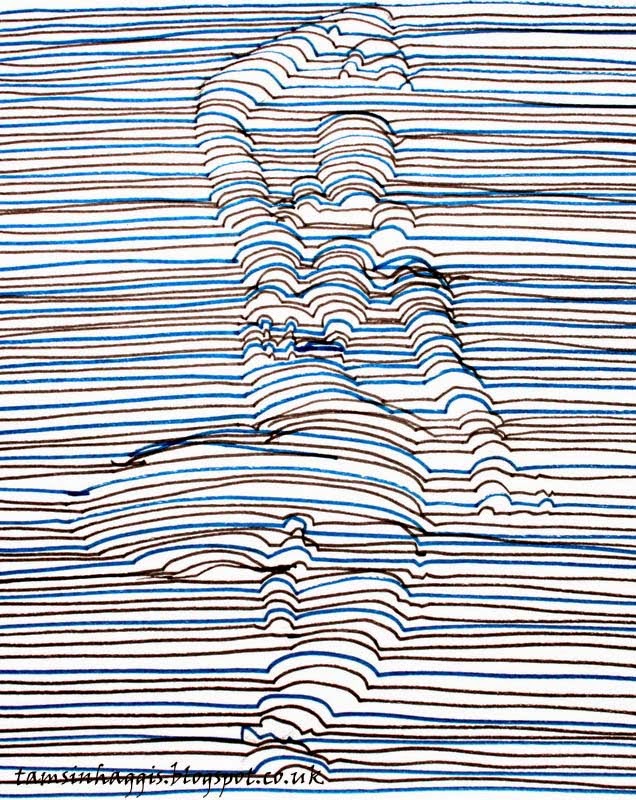
blue-lotus dark and cloud-dark
'...Now I shall speak to you about the division of dark and white... of different colours in this world, from which the two-fold colour of all is explained (ie. the light and dark shade of every colour).
Among these colours, the white (light shade) should be of five kinds and dark of twelve kinds. Bright (gold), light (white), tooth white, pure sandal-white, autumn-cloud-white and autumn-moon-white - these five traditionally are called the fivefold white (light shade).
The varieties of dark should be: reddish-dark, brownish-dark, sprout (greenish) dark and grayish dark, tawny dark and topaz dark, creeper-dark and monkey dark. Then come blue-lotus dark and blue as the nilakantha bird, and purple-lotus dark and cloud-dark.'
Vishundharmottara Purana, Part 111, ch 27
.
Thursday, 9 October 2014
art in the world
I'm currently working on pulling together some of the different strands of the work I've been doing over the last few years, which has so far appeared in a largely instinctive and intuitive way. This year, however, I've learnt that working entirely intuitively can be dangerous - you can get derailed and lose your way.
I want to be clearer not only about some of the themes and ideas that I'm interested in, but also about what my art is trying to do in the world. Because although I'm fascinated by the details of the creative process, and all the ways that people seem to so often get in its way, I'm also interested in art as something more than a personally satisfying project. And, I have to say, art as something more than what is trending in the Cork Street galleries in London or what is currently deemed to be fashionable or worth investing in.
Perhaps one of the things that has always attracted me to Indian art is that traditionally, art in India was never made purely for the satisfaction of the individual artist. I guess you could come back against that and say, well, the great artists in the European and America traditions weren't just working for their own satisfaction either, they were driven by a compulsion to open art up in new ways; to push and explore, to move the history of art on into a new world.
The European/American project has been exhilarating, and even now, when you could argue that it becomes harder and harder to make visual work that cracks things open in this way, it still is. The direction that mainstream/gallery art has taken over the last few decades, however, has been increasingly conceptual, with the visceral, experiential and aesthetic somewhat falling out of favour. The purpose of art is often now described as being 'to challenge you and make you think' rather than any number of other purposes that might be tied to the lusciousness of colour, the voyaging of the imagination, or philosophical ideas that are not directly to do with art and/or the idea of art 'for its own sake'.
So what about the aesthetic? What of the power of the visual to reach in and touch people's souls; to lift them out of despair or expand them into a greater sense of connectedness and joy? What of a visceral response to colour and form, that can actually produce an altered experience of being in the world, even if only for a moment?
In India, at least perhaps until the 19th or 20th centuries, the purpose of pretty much all art was at the very least to use the power of aesthetics to suggest or teach philosophical ideas. Aesthetics was also used to try to actively create specific experiential effects in the viewers of art. The theory of rasa, for example, laid out the means for creating specific emotions in the audience (such as longing, passion, betrayal etc), and informed all art forms, including miniature painting, theatre, poetry, dance and music. On top of this, aesthetic forms in some contexts were, and often still are, believed to have actual powers in the physical world.
Until recently, it would have been possible to take a calmly Post-Enlightenment rationalist view of all this and say, 'Well, that's all very well, but now we know that ideas are all relative, there's no universally agreed idea to teach or illuminate, and that's not the purpose of art anyway. We all believe different things, which we project onto objects and situations, and obviously images don't have real power'. Recent work in medicine, psychology and the sciences related to health, well-being and stress (which includes the work on placebo), however, ought to give us pause for thought about being completely dismissive of the idea that there could be a connection between emotional and psychological states (including beliefs) and the biology of the body. Biochemical markers detectable in the blood have been show to be associated with certain orientations, beliefs, feelings of stress, and the onset of certain types of illness.
From this point of view, contemporary art practices can do what they like in terms of challenge and ideas and confrontation, but is there not also an individual, indeed, a societal need, for aesthetic art forms; for visual images which move the kidneys, not just the mind? Images which have the intention not of commenting upon social isolation or the horrors of human existence, for example, but of enlivening/ embracing/encircling actual socially isolated, disconnected or otherwise stressed out human beings?
When I brought together four years of work under the title of 'Wild Life' for my exhibition in 2013, I realised that I had unconsciously been making art which was trying to articulate the miracle of being alive; of the beauty of the world even in its horror (see how beautiful a deadly bacteria can be?), and of the extraordinariness of being made of the same stuff as slime mould, mackerel skies and apples falling onto people's heads.
I realised that I had been, and am, working unfashionably and unashamedly with the aesthetic, and with the power of the aesthetic to promote visceral, non-verbal responses. The responses that interest me are not shock, horror, disbelief, self-questioning, or the sense that what a person might be looking at is wildly original or new. I'm interested in things such as awe, fascination, wonder, a sense of mystery, and how these sensations can be stimulated through conscious or unconscious resonances set up by visual forms that echo the shapes and forms of the natural world.
I don't just want to make visual forms that have the possibility of stimulating a 'sense of connection with' the natural world. The resonance I'm after is deeper than that. It is the sense that I, the viewer and/or the maker of this image/performance, am myself a miracle of biological life; and furthermore, that I'm not 'connected' (which implies one thing connected to another) 'to' the world around me, but that I am an actual biological emanation of planetary life processes from which I am in no way separate at all.
Why does this matter? There's a lot of talk in publications such as New Scientist about one of the problems of climate change and planetary destruction being that it is too easy for people to distance themselves from it. Either you're living somewhere where you can actually see the destruction (ie. an inuit in the arctic wastes) but have no power, or you're living somewhere where you have power (in terms of political lobbying, control over patterns of consumption, ability to protest etc) but you don't see anything around you that tells you that what we have now is a human and planetary emergency.
My art emerges from the deep, visceral knowledge that I/we are nature and the planetary world. We emerge daily from dynamic processes which involve cells and fibres and structures that share shapes and structures and flows with any number of things in the world that we can physically see. And it is our body which is being attacked, not something happening far away.
Unlike classical Indian artists, I know that, whatever my intention, I have no control over what kind of response a viewer is going to have to a painting within the space of their own body and awareness. But I offer my own experience of and response to these things in the hope of resonance, for the sake of my rivers, my skies and my future.
Friday, 25 July 2014
Sunday, 29 June 2014
sandpainting rationale
Sandpainting is an evolution from my studies of Indian Art and my work with complexity and dynamic systems theories.
Dynamic
systems theories (closely related to chaos theories) seemed to me to provide a
science-based, theoretical articulation of many of the insights and principles
that fascinate me in Indian philosophies and Indian theories of aesthetics.
From Indian philosophy: cyclical
time, constant movement and change (impermanence), the natural realities of
endless creation and dissolution, the world as fundamentally interconnected on
all levels, the world-creating possibilities of sound and vibration
(particularly the human voice), the changeable and problematic nature of the
human mind.
From dynamic systems
theories:
the reality of constant change and evolution (repetition and novelty), the
interconnectedness and unpredictability of living systems, the mystery of
emergence and sudden collapse (feedback, resonance and amplification), the
world as an interconnected web of multiple ecologies.
From Indian
aesthetics:
art as a contemplative act, aesthetic perfection as a means of stilling and
focusing the mind, stillness as a means of perceiving interconnectedness with
all of life.
In
a world dominated by the goal of technological and medical progress, obsession
with the culture of celebrity, myriad forms of displacement activity, and
increasing personal alienation, it seems to me that many people are longing for
a deep, resonating, visceral reconnection with themselves as interconnected
elements of the natural world. This is the intention of sandpainting as performance.
Sunday, 8 June 2014
what's it all about, where is it going?
A statement I prepared for Open Studios, at Marcelle House, Alloa, in June, 2014.
What's it all about?
I studied art at the Berkshire College of Art, Reading, and St Martin's School of Art, London. I then trained as an English Language Teacher and spent 10 years working in Italy, India, Japan and Australia, whilst trying to keep my painting alive. In 1991 I did a BA in Indian Art and Philosophy, and in 1996 a Masters in Adult Education. I was an Education lecturer and researcher in the university sector for fourteen years, publishing widely at postdoctoral level.
Music and art have been with me since I was very young. After my early experiences of art school brought me more or less to a creative standstill, I had a sporadic relationship with both until 2004, when I began once again to try to learn to improvise on the violin. In 2009 I started painting again, and in 2012 I started singing. I’ve been a full time artist since 2010, working regularly with Kath Burlinson and Paul Oertel on their Authentic Artist and Discipline of Freedom workshops. The astonishing work of these two teachers has finally allowed me to bring art, music, dance, writing and song together.
The paintings which began to appear in 2009 surprised nobody more than me. My art-starved soul finally found a way to circumvent my habitual attitudes and habits of thought and began to produce various types of process-based work which I did not consciously direct. After some time, I began to see that the shapes and fractal patterns that were emerging were a visual exploration of ideas that I had been exploring for over twenty years in a variety of professional contexts.
I tried to follow my fractal-based process with as little interference as possible, observing it, and writing about it on Exploring Creativity, the blog I have been writing since 2009.
In September 2013 I had my first solo exhibition, Wild Life, as part of the Stirling Fringe Festival, which included a performance poet and live sand painting.
While I've been exploring undirected fractal colours (literally and materially, in the form of watery paint...) I've been wondering how my work is going to connect to my Indian studies. I did my thesis on the embodiment of god in sacred images, and at first I thought that the gods were going to make an appearance. But everything that has appeared so far has been connected to dance and music. I've been back to India twice in the last two years, and on my most recent trip made an in-depth study of Hoysala temple carvings at three sites in Southern Karnataka.
Where is it going?
I described the focus of Wild Life, my first show, as follows:
Wild Life is a celebration of life across all levels of scale. It's a celebration of the creative processes that occur in the self-organising forms of slime moulds and beehives, of shell shapes and eco-systems, of cloud banks and human minds... of the patterns of cracked earth and frosted windows, of stomach viruses and cellular formations, and the colours of rock, sea and eroded stone.
The next show will probably be called something like Human Life. Having been exploring the fractal forms of wet paint, echoing cells and membranes, sea shells and coastlines, eco-systems and galaxies, my challenge now is to consider how to place humans in the midst of this fractal complexity:
How to suggest the idea that humans are but tiny specks in a vast universe?
To challenge the Biblical idea of humans being superior to, and having dominion over, nature (the idea that nature is 'there' for humans to use and exploit).
How to express the idea that as humans we are not distinct from plants, or trees, or animals, or viruses?
To challenge more recent ideas about the human connection to nature. I'd like to somehow give visual expression to the idea that the human/nature relationship goes far beyond the idea of connection - that humans are nature. The clouds, the frozen ice, your toe, the milk in the glass, your feeling of hurt, the grass beneath your feet; that it's all the same stuff.
How to suggest the free, joyous potential of being a speck of human consciousness in a connected universe?
How to suggest the coexistence of the dark with the light, of death with regeneration, of cycles rather than progressive trajectories?
Might it be possible to allude to what happens when none of this is considered; when as human beings we live feeling distinct and separate?
In 2014 I'm trying to focus entirely on this next phase of my work and don't intend to be participating in any public forums or exhibitions. But if you're interested in what I'm doing I always love to see people, so please get in touch at tamsin.haggis@gmail.com.
.
I studied art at the Berkshire College of Art, Reading, and St Martin's School of Art, London. I then trained as an English Language Teacher and spent 10 years working in Italy, India, Japan and Australia, whilst trying to keep my painting alive. In 1991 I did a BA in Indian Art and Philosophy, and in 1996 a Masters in Adult Education. I was an Education lecturer and researcher in the university sector for fourteen years, publishing widely at postdoctoral level.
Music and art have been with me since I was very young. After my early experiences of art school brought me more or less to a creative standstill, I had a sporadic relationship with both until 2004, when I began once again to try to learn to improvise on the violin. In 2009 I started painting again, and in 2012 I started singing. I’ve been a full time artist since 2010, working regularly with Kath Burlinson and Paul Oertel on their Authentic Artist and Discipline of Freedom workshops. The astonishing work of these two teachers has finally allowed me to bring art, music, dance, writing and song together.
The paintings which began to appear in 2009 surprised nobody more than me. My art-starved soul finally found a way to circumvent my habitual attitudes and habits of thought and began to produce various types of process-based work which I did not consciously direct. After some time, I began to see that the shapes and fractal patterns that were emerging were a visual exploration of ideas that I had been exploring for over twenty years in a variety of professional contexts.
I tried to follow my fractal-based process with as little interference as possible, observing it, and writing about it on Exploring Creativity, the blog I have been writing since 2009.
In September 2013 I had my first solo exhibition, Wild Life, as part of the Stirling Fringe Festival, which included a performance poet and live sand painting.
While I've been exploring undirected fractal colours (literally and materially, in the form of watery paint...) I've been wondering how my work is going to connect to my Indian studies. I did my thesis on the embodiment of god in sacred images, and at first I thought that the gods were going to make an appearance. But everything that has appeared so far has been connected to dance and music. I've been back to India twice in the last two years, and on my most recent trip made an in-depth study of Hoysala temple carvings at three sites in Southern Karnataka.
Where is it going?
I described the focus of Wild Life, my first show, as follows:
Wild Life is a celebration of life across all levels of scale. It's a celebration of the creative processes that occur in the self-organising forms of slime moulds and beehives, of shell shapes and eco-systems, of cloud banks and human minds... of the patterns of cracked earth and frosted windows, of stomach viruses and cellular formations, and the colours of rock, sea and eroded stone.
The next show will probably be called something like Human Life. Having been exploring the fractal forms of wet paint, echoing cells and membranes, sea shells and coastlines, eco-systems and galaxies, my challenge now is to consider how to place humans in the midst of this fractal complexity:
How to suggest the idea that humans are but tiny specks in a vast universe?
To challenge the Biblical idea of humans being superior to, and having dominion over, nature (the idea that nature is 'there' for humans to use and exploit).
How to express the idea that as humans we are not distinct from plants, or trees, or animals, or viruses?
To challenge more recent ideas about the human connection to nature. I'd like to somehow give visual expression to the idea that the human/nature relationship goes far beyond the idea of connection - that humans are nature. The clouds, the frozen ice, your toe, the milk in the glass, your feeling of hurt, the grass beneath your feet; that it's all the same stuff.
How to suggest the free, joyous potential of being a speck of human consciousness in a connected universe?
How to suggest the coexistence of the dark with the light, of death with regeneration, of cycles rather than progressive trajectories?
Might it be possible to allude to what happens when none of this is considered; when as human beings we live feeling distinct and separate?
In 2014 I'm trying to focus entirely on this next phase of my work and don't intend to be participating in any public forums or exhibitions. But if you're interested in what I'm doing I always love to see people, so please get in touch at tamsin.haggis@gmail.com.
.
Subscribe to:
Posts (Atom)